
You are standing at a busy table, the wheel is spinning, and you are holding a stack of 100,000 Toman chips. You watch the dealer flick the ivory ball in the opposite direction. Your gut tells you to throw a few chips on black, some on your birthdate, and a few on a random corner. This is the exact moment of illusion—and the reason casinos can afford to build massive, luxurious resorts.
Unlike card games like poker or blackjack, roulette is a game of purely independent events. The wheel has no memory, no patterns to exploit, and absolutely no room for psychological maneuvers. This guide will walk you through the raw math, the structural differences between table layouts, and the cold reality of betting systems so you can understand how to play roulette with clinical, mathematical realism.
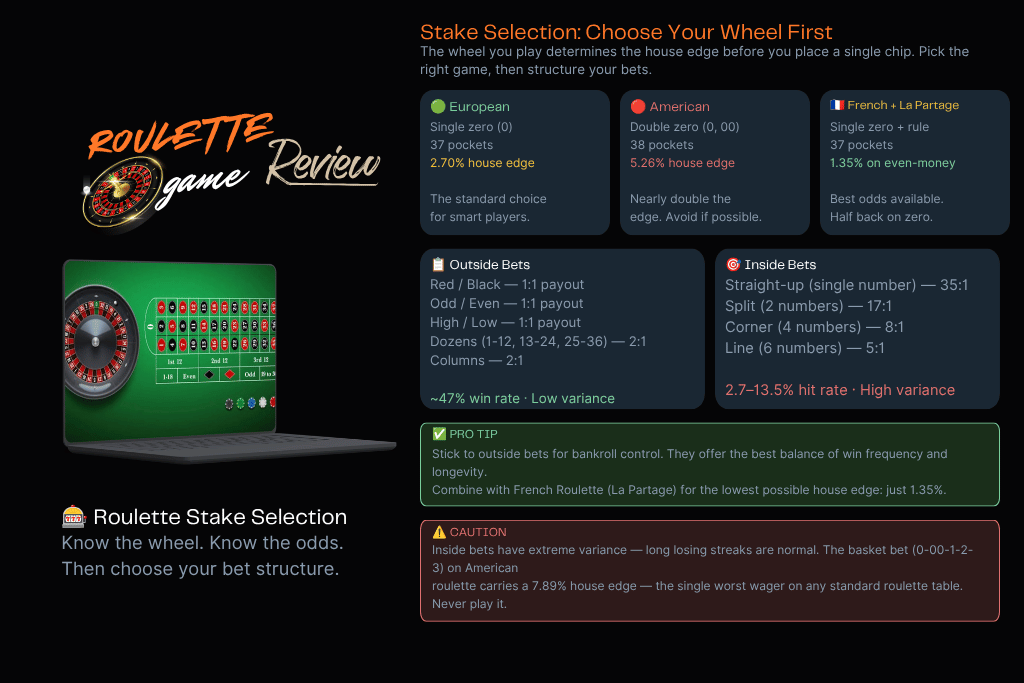
The most important decision you make during a session happens before you place a single bet. It is the choice of wheel. Many casual players treat all tables as identical, which is a catastrophic financial mistake.
0 pocket. Because of this single zero, the roulette house edge is locked at a steady 2.70% across almost every bet on the board.00. Because of this extra green pocket, the house edge nearly doubles to a punishing 5.26%.Concrete strength: Single-zero European tables offer a highly competitive house advantage. If you can find a French Roulette table that features the La Partage rule, the house edge on even-money bets (like Red/Black) drops to an incredibly low 1.35%, as the house returns half of your stake if the ball lands on the green zero.
Honest limitation: If you sit at an American double-zero wheel, you are voluntarily doubling the speed at which the casino drains your bankroll. Over a standard session, the extra green pocket acts as a quiet tax that completely destroys your statistical chances of walking away with a profit.
To play effectively, you must understand how roulette strategy and payouts are structured. Bets are divided into two main sections on the table layout:
These are wagers placed on large groups of numbers outside the primary grid. Even-money bets (Red/Black, Odd/Even, High/Low) cover 18 numbers and pay out 1:1. Dozens and Columns cover 12 numbers and pay out 2:1.
These are wagers placed on specific numbers inside the grid. A Straight-up bet (a single number) pays a massive 35:1. Splits (two adjacent numbers) pay 17:1, Corners (four numbers) pay 8:1, and Lines (six numbers) pay 5:1.
Practical tip: Never place the “Basket” or five-number bet (covering 0, 00, 1, 2, and 3) on an American wheel. The payout is 6:1, but the true odds make the house edge on this specific bet jump to 7.89%. It is mathematically the worst wager on the layout.
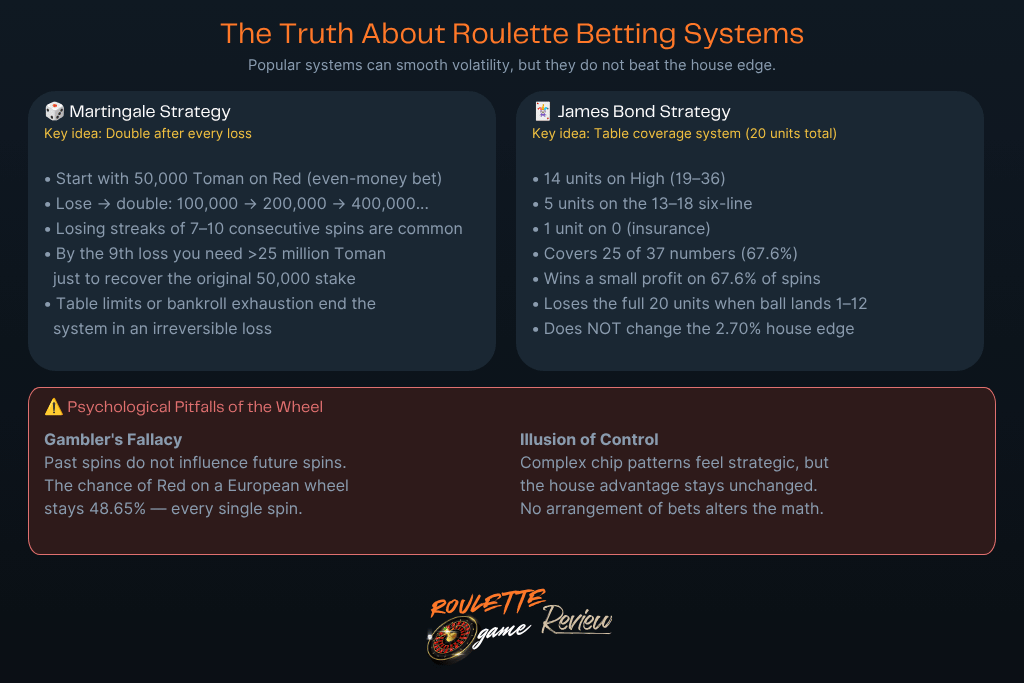
If you search the internet, you will find countless guides promoting “guaranteed” or best roulette betting systems. Let’s analyze the most popular approaches with strict mathematical realism.
This system requires you to place a 50,000 Toman bet on an even-money option like Red. If you lose, you bet 100,000 Toman. If you lose again, you bet 200,000 Toman, and so on.
This flat-betting system typically uses 20 units total. You place 14 units on High numbers (19–36), 5 units on the 13–18 Line, and 1 unit on the green 0. This covers 25 out of 37 numbers (67.6% of the wheel).
The physical design of the roulette table is optimized to trigger two primary cognitive biases:
Roulette is a pure game of chance designed for passive, high-variance entertainment.
Who should play roulette:
Who should look elsewhere:
Before you spin:
Our verdict: Roulette is a classic, enjoyable casino game, but it must be treated as paid entertainment. If you utilize progressive betting systems with the expectation of making a consistent profit, the cold mathematics of the wheel will eventually empty your account.
Why is American roulette considered a bad bet?
American roulette features an extra green 00 pocket, bringing the total number of pockets to 38. Because the payout for winning bets remains the same as European roulette (which has only 37 pockets), the house edge nearly doubles from 2.70% to 5.26%. This makes winning in the long term much more difficult.
What is the “La Partage” rule in French roulette?
The La Partage rule applies strictly to even-money bets (Red/Black, Odd/Even, High/Low) on a single-zero wheel. If the ball lands on the green 0, the player gets exactly half of their wager back instead of losing the entire bet. This cut in half reduces the house edge on even-money bets to a highly favorable 1.35%.
Does the James Bond strategy guarantee a profit?
No. No betting system can alter the house edge. While the James Bond system covers 67.6% of the wheel and yields frequent small wins, a single loss on a low number (1–12) wipes out all of your progress, requiring many consecutive wins to recover.
Can a dealer intentionally land the ball on a specific number?
No. Modern casino wheels are engineered with high-precision balances, and the speed of the wheel and ball are highly irregular. Additionally, dealers are trained to change their release speed to prevent any consistent “dealer signature” from forming. Every spin is completely random.
How does the Martingale system fail in real-world play?
The system fails because of exponential growth and table limits. If you double your bet size after every loss, a standard losing streak of just nine spins will turn a 50,000 Toman bet into a 25.6 million Toman wager just to recover your original 50,000 Toman. Most tables have maximum bet caps that will block you from doubling your bet long before you can recover.
Which bet on the roulette table has the lowest house edge?
The lowest house edge is found on even-money bets (Red/Black, Odd/Even, High/Low) on a French Roulette table that features the La Partage or En Prison rules. This specific setup drops the house edge to 1.35%, making it the most player-friendly option on the wheel.



An objective review of the Bet404 betting platform for Iranian players. This guide evaluates its game selection—including traditional Persian card games like Hokm—deposit and withdrawal speeds, the Android APK, and critical considerations like licensing and support language barriers.

JetBet is a Persian‑focused sportsbook and casino with diverse local games, live dealer tables, and a clean interface. Bonuses carry steep 40x wagering, withdrawals capped at 5M Tomans daily, and licensing transparency is absent.

TinyBet is a Persian‑focused sportsbook and casino with a clean mobile APK, strong live betting, and a 200% sports bonus. Withdrawals are capped at 20M Tomans daily, bonuses exclude casino games, and licensing transparency is absent.

Betkhane is a Persian‑focused sportsbook and casino with polished design, strong live dealer tables, and multiple payment options. Bonuses carry a 12x rollover, withdrawals capped at 10M Tomans daily, and verification delays of 24‑48 hours.

Enfejbaz is a Persian‑focused crash game platform with multiple Enfejar versions, card games, and sports betting. Bonuses are simple but vague, withdrawals capped daily, and no visible license adds risk.

Ace90 is a Persian‑focused casino and sportsbook with deep local game variety and strong payment options. Bonuses carry strict 48‑hour, 5‑bet requirements, withdrawals are capped daily, and licensing transparency is absent.